Your crew is honest.
Time still slips away.
Most of the people working your fields would never take a dollar that isn't theirs. But minutes are different. They drift — by accident as often as on purpose — and across a full season they add up to real money. Here's what that quietly costs a farm, and how to close the gap without treating anyone like a suspect.
"It isn't that workers are stealing time. It's that you don't have an accurate way to measure it."
It's rarely about dishonesty
The phrase sounds dramatic, and that's part of why farmers tend to wave it off. "Not my people." And they're usually right — most time loss has nothing to do with someone trying to cheat you.
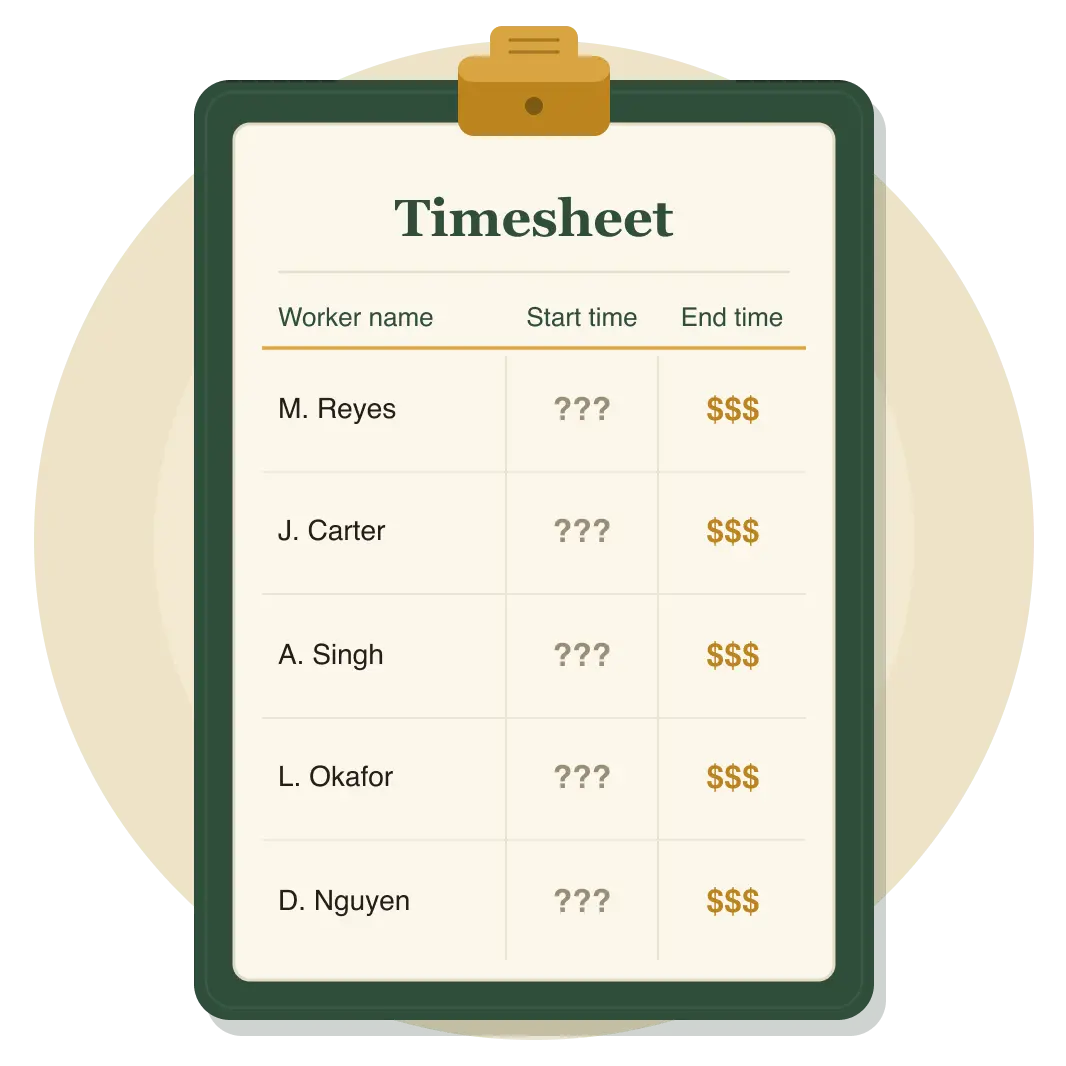
It looks like a paper timesheet filled in from memory at the end of a long day. A start time rounded to the nearest quarter hour, every day, for thirty workers. A supervisor estimating hours for a crew spread across three fields because there was no easier way. A break that ran a little long. Small, ordinary, run-of-the-mill discrepancies.
The trouble is the multiplication. A few minutes per person, per day, across an entire crew and a full growing season, becomes a number most operations would be surprised to see written down.
Where the minutes tend to go
None of these require bad intent. Most happen because manual tracking simply can't keep up with a moving crew.
Rounded start times
"Close enough" clock-ins nudged to the top of the hour. A few minutes each, every shift, quietly compounding.
Buddy punching
One worker clocking in for another who's running late. Easy to do on paper or a shared device, hard to catch.
Untracked breaks
Breaks that stretch past their length, or aren't recorded at all, because there's no simple way to log them in the field.
Memory & estimates
Hours written down hours later, or estimated by a supervisor for a whole crew. Honest guesses are still guesses.
Remote, scattered crews
Workers across multiple blocks and fields are nearly impossible to verify from a single sign-in sheet at the shed.
Recordkeeping gaps
Paper records that are hard to reconcile at payroll — and harder still to produce cleanly if you're ever audited.
Closing that gap costs far less than leaving it open.
$40*/mo
* for active Farm Bureau members in participating states.
Non-Farm Bureau plans start at $50/mo.
Five minutes a day adds up
Even a small daily gap, spread across your crew and your season, lands somewhere most farms wouldn't expect.
According to a study by the American Payroll Association, time theft costs businesses an estimated 1.5% - 5% of their gross annual payroll.
Think about that...
-
7-24 minutes per day per employee, or...
-
$17-58 per month per employee, or...
-
2-7x what FieldClock costs (based on a 5-employee crew)
Accurate time protects everyone
Accurate time tracking protects your honest workers first — they get paid for every minute they actually put in, and there's no dispute when payday comes around.
It protects you, too. Clean, verifiable records mean fewer payroll headaches, fewer disagreements, and a clear trail if you're ever asked to show your work — whether that's for an audit, a compliance review, or simply your own peace of mind.
Good tools don't replace trust.
They remove the guesswork that quietly erodes it.