Using a farm labor contractor doesn't move the risk off your farm
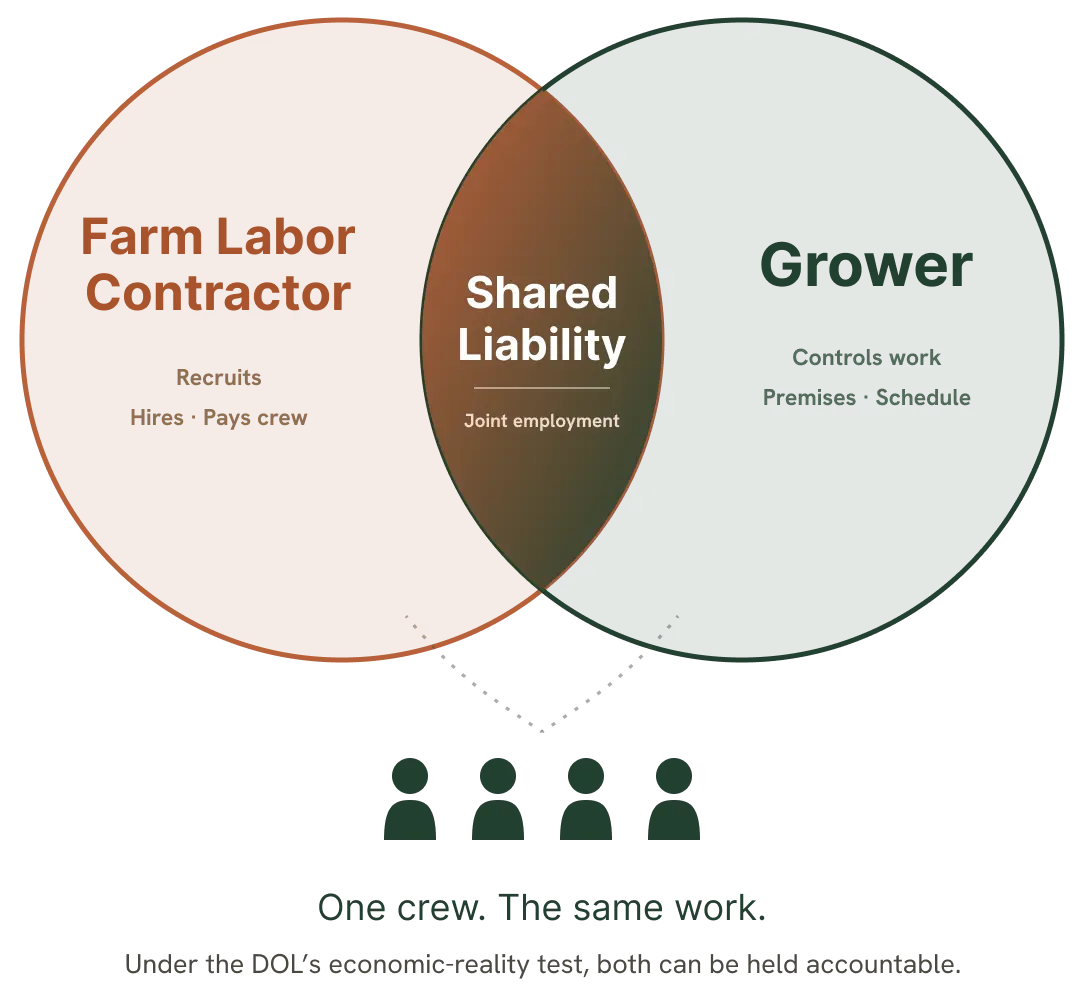
It's a common and reasonable assumption: hire workers through a farm labor contractor (FLC), and compliance becomes their problem. But under the Department of Labor's joint employment analysis, your operation can still share the liability — often for records you never get to see.
"My contractor handles all of that"
Many growers are told — and reasonably believe — that working through an FLC transfers responsibility for wages, housing, recordkeeping, and H-2A rules to the contractor. The contractor recruits, hires, and pays the crew, so the compliance burden seems to travel with them.
It's true that the FLC is responsible for following the laws that apply to the workers. What's less obvious is that this responsibility doesn't automatically replace yours. The DOL frequently treats the grower and the contractor as joint employers — meaning both can be held accountable for the same violations.
This isn't a reason to stop using contractors. It's a reason to understand where your exposure actually sits.
Vertical joint employment, in plain terms
The DOL looks at the economic reality of the arrangement, not just who signs the paychecks. If the workers are economically dependent on your operation, you may be considered a joint employer of the entire crew the FLC provides.
| ✓ | Both parties become liable. | A joint employment finding makes the grower and the contractor jointly responsible for compliance and for any violations. |
| ✓ | It applies to all the workers. | If the FLC is found to be your joint employer, every worker they supply is generally treated as yours too. |
| ✓ | Same work, same risk. | When contractor crews perform the same activities as your direct employees, the DOL has consistently found joint employment. |
| ✓ | It can reach H-2A obligations. | Joint employment can pull your direct workers under H-2A requirements, including the adverse-effect wage rate, housing, and transportation. |
When you outsource the labor, it's easy to outsource the visibility too — but you can't outsource the liability.
Six signals that point toward joint employment
No single factor decides the outcome — the DOL weighs the whole picture. The more of these that describe your operation, the more likely a joint employment finding becomes.
Control & supervision
You direct which fields are worked, the pace, or the daily schedule — directly or through the contractor.
Hiring & terms
Your operation can effectively hire, fire, set conditions, or change pay rate or method of payment.
Your premises
The work is performed on land you own or control, season after season.
Integral to the operation
The work — picking, pruning, packing — is central to your business, not a one-off service.
Employer functions
You handle payroll, track output per hour, withhold for workers' comp, or manage similar tasks.
Tools & infrastructure
You supply buckets, equipment, transportation, housing, or other materials the crew relies on.
The visibility gap
-
The FLC keeps the wage and hour records.
-
You rarely see how the crew was actually paid.
-
Housing and disclosure documents stay with the contractor.
But...
-
The liability can still land on your operation.
You're often sharing the risk without sharing the records.
This is the part that catches growers off guard. The contractor carries the compliance obligations and the documentation that proves they were met. If the DOL comes calling and you're treated as a joint employer, you're answering for records you may have never seen.
The most protected operations aren't the ones that avoid contractors — they're the ones that keep their own clear, defensible record of hours, pay, and worker activity, so they can demonstrate compliance regardless of who supplied the crew.
This page is provided for general educational purposes and does not constitute legal advice. Joint employment determinations depend on the specific facts of each operation. Consult qualified counsel for guidance on your situation.